Quick Guide: Ananda Balasana at a Glance
- Sanskrit Name: Ananda Balasana (आनन्द बालासन) — Ananda (Bliss / Joy) + Bala (Child) + Asana (Posture).
- Common English Name: Happy Baby Pose.
- Pose Type: Supine hip opener and restorative counter-posture.
- Key Anatomical Focus: Sacroiliac (SI) joint decompression, adductor release, and pelvic floor relaxation.
- Golden Rule: Keep your tailbone, sacrum, and back of the head firmly anchored to the mat. Never sacrifice spinal length to reach your feet.
Watch any infant lying on their back and you will notice a natural, spontaneous posture: clutching their feet, pulling their knees toward their armpits, and gently rocking with complete ease. They carry none of the chronic pelvic gripping, lumbar compression, or postural guardedness that adults accumulate through years of desk sitting and psychological stress.
In modern yoga, Ananda Balasana (Happy Baby Pose) consciously returns the adult body to this state of effortless mobility. While often treated as a playful transitional posture at the end of a vigorous Vinyasa or Hatha sequence, Ananda Balasana is a clinically potent therapeutic pose. When performed with precise alignment, it gently decompresses the lumbar spine, mobilizes the hip joints, and calms the autonomic nervous system without placing weight on vulnerable joints.
What is Ananda Balasana? (Sanskrit Meaning & Origins)
The name is derived from three classical Sanskrit terms:
- Ananda (आनन्द): Unconditioned joy, spiritual bliss, or divine contentment.
- Bala (बाल): A young child or infant.
- Asana (आसन): A stable, comfortable posture.
In traditional yogic philosophy, the word Ananda is not simply fleeting emotional happiness—it refers to the intrinsic nature of the soul (Anandamaya Kosha), free from anxiety and ego defense. In Ananda Balasana, the practitioner mimics an infant’s complete trust in gravity, allowing the breath to settle into the lower belly while the hips surrender their defensive tension.
The Biomechanics: Why Happy Baby Pose Releases Hips & Lower Back
Many practitioners struggle with seated hip openers like Padmasana (Lotus Pose) or Baddha Konasana (Bound Angle) because gravity and tight hamstrings pull the pelvis into a posterior slump, forcing the lower back to round painfully. Ananda Balasana solves this through three distinct biomechanical advantages:
1. Gravity-Assisted Hip Abduction & Flexion
Because you are lying flat on your back, the floor acts as an objective alignment board. Gravity assists the knees downward past the torso, stretching the adductor magnus, gracilis, and pectineus muscles of the inner groin without requiring muscular straining.
2. Sacroiliac (SI) Joint Decompression
The combination of wide hip flexion and gentle downward manual pressure on the feet gently separates the posterior iliac crests from the sacrum. This micro-decompression relieves trapped nerve tension across the lumbosacral junction (L4–S1), making it deeply soothing for individuals suffering from mild sciatica or lower-back stiffness.
3. Pelvic Floor (Levator Ani) Relaxation
Modern posture and chronic stress cause many adults to hold unconscious tension in the pelvic diaphragm. The wide-legged supine position of Ananda Balasana naturally stretches and softens the pelvic floor muscles, supporting healthy bladder, bowel, and reproductive organ circulation.
Step-by-Step Alignment Guide: How to Perform Ananda Balasana Correctly
To receive the therapeutic rewards of Happy Baby Pose without pulling your neck or straining your lower back, follow this step-by-step cueing protocol:
- Establish Supine Base: Lie flat on your back on your yoga mat. Take a slow, settling exhalation to allow your shoulder blades and the back of your head to rest heavily on the floor.
- Draw Knees Wide: On an exhale, bend both knees and draw them toward your belly. Then separate your knees wide, steering them toward your outer armpits or ribs, rather than into your chest.
- Position Shins Vertically: Flex your ankles so the soles of your feet face directly up toward the ceiling. Align your ankles directly over your knees so your shins are strictly perpendicular to the floor.
- Take Your Grip: Reach your hands up and grasp the outside edges of your feet (pinky-toe side). If reachable without tension, you may hook your index and middle fingers around your big toes (Padangusthasana grip).
- Anchor the Sacrum: Consciously press your tailbone and sacrum downward into the mat. Do not allow your pelvis to curl up into the air. Draw your shoulder blades gently down your back away from your ears.
- Apply Gentle Downward Traction: Use the weight of your arms to guide your knees closer to the floor alongside your torso, while simultaneously pressing your feet upward into your hands to create gentle, stabilizing isometric resistance.
- Breathe & Hold: Breathe smoothly into the lower abdomen for 5 to 10 slow diaphragmatic breaths (roughly 1 to 2 minutes). Feel the belly expand between your thighs on each inhalation, and soften deeper into the earth on each exhalation.
- Gentle Release: To exit, exhale, release your feet, bring your knees together, and place your feet flat on the floor with knees bent for a few moments to allow the spine to neutralize.
3 Essential Modifications for Tight Hips & Stiff Backs
Never force your body into a posture if your alignment collapses. If reaching your feet causes your head to tilt back or your tailbone to roll off the mat, use these classical modifications:
1. Grasping the Back of the Thighs or Calves
If your hamstrings or inner groins are tight, holding the soles of the feet forces the shoulders and tailbone off the floor. Simply hold onto the backs of your thighs just below the knee creases, or grasp your calves. This allows your entire spine to remain completely grounded while still opening the hips.
2. Using a Yoga Strap Across the Soles
Loop an unbuckled yoga strap across the arches of both feet, holding the strap ends with each hand. This extends your reach by several inches, letting your upper back, shoulders, and neck rest completely tension-free on the floor.
3. Half Happy Baby Pose (Ardha Ananda Balasana)
Practice on one leg at a time while keeping the opposite foot flat on the floor with the knee bent (or extending the opposite leg long along the mat). This isolates one hip joint at a time, making it much easier to keep the pelvis level and stable.
Top 6 Therapeutic Benefits of Happy Baby Pose
- 1. Deep Adductor & Groin Flexibility: Safely opens the inner thighs without placing twisting torque on the knee joints.
- 2. Natural Lower Back Decompression: By grounding the sacrum and drawing the thighs down, it restores length to the quadratus lumborum and erector spinae muscles after long hours of seated compression.
- 3. Calms the Central Nervous System: Supine hip opening combined with deep belly breathing stimulates the vagus nerve, reducing mental agitation, heart rate, and fatigue.
- 4. Relieves Pelvic Floor Hypertonicity: Gently stretches tight pelvic floor tissues, helping ease chronic pelvic discomfort and supporting healthy elimination.
- 5. Ideal Counter-Pose for Backbends: Neutralizes the lumbar spine after intense spinal extensions such as Urdhva Dhanurasana (Wheel Pose), Ustrasana (Camel), or Shalabhasana (Locust).
- 6. Improves Emotional Grounding: As hips are known somatically to store chronic stress and fight-or-flight tension, holding Ananda Balasana provides a safe, grounded posture to process and release emotional gripping.
Common Alignment Mistakes to Avoid
- Lifting the Tailbone off the Floor: The single most common mistake. When the pelvis lifts, the lower back rounds into flexion, completely defeating the purpose of sacral grounding. Keep your tailbone rooted to the mat, even if you need to hold your thighs instead of your feet.
- Hyperextending the Neck: If your chin points up toward the ceiling and your throat feels constricted, your cervical spine is compressed. Tuck your chin slightly to lengthen the back of your neck, or place a thin folded blanket beneath your skull.
- Angling the Feet Outward or Inward: Keep your ankles directly stacked over your knees. If your feet are pulled together in front of your pelvis, you are practicing a supine Baddha Konasana rather than Happy Baby Pose.
Safety & Contraindications
Ananda Balasana is gentle and accessible, but modify or skip the posture if you have:
- Acute Knee or Meniscus Injuries: Avoid pulling forcefully down on the feet. Stick to holding the thighs or practice gentle supine stretches.
- Cervical Neck Strain: Always support the head with a firm folded blanket to prevent hyperextension.
- Second or Third Trimester of Pregnancy: Avoid extended periods lying flat on your back (supine hypotensive syndrome). Practice supported seated hip openers instead.
Experience Restorative Healing Along the Sacred Ganga
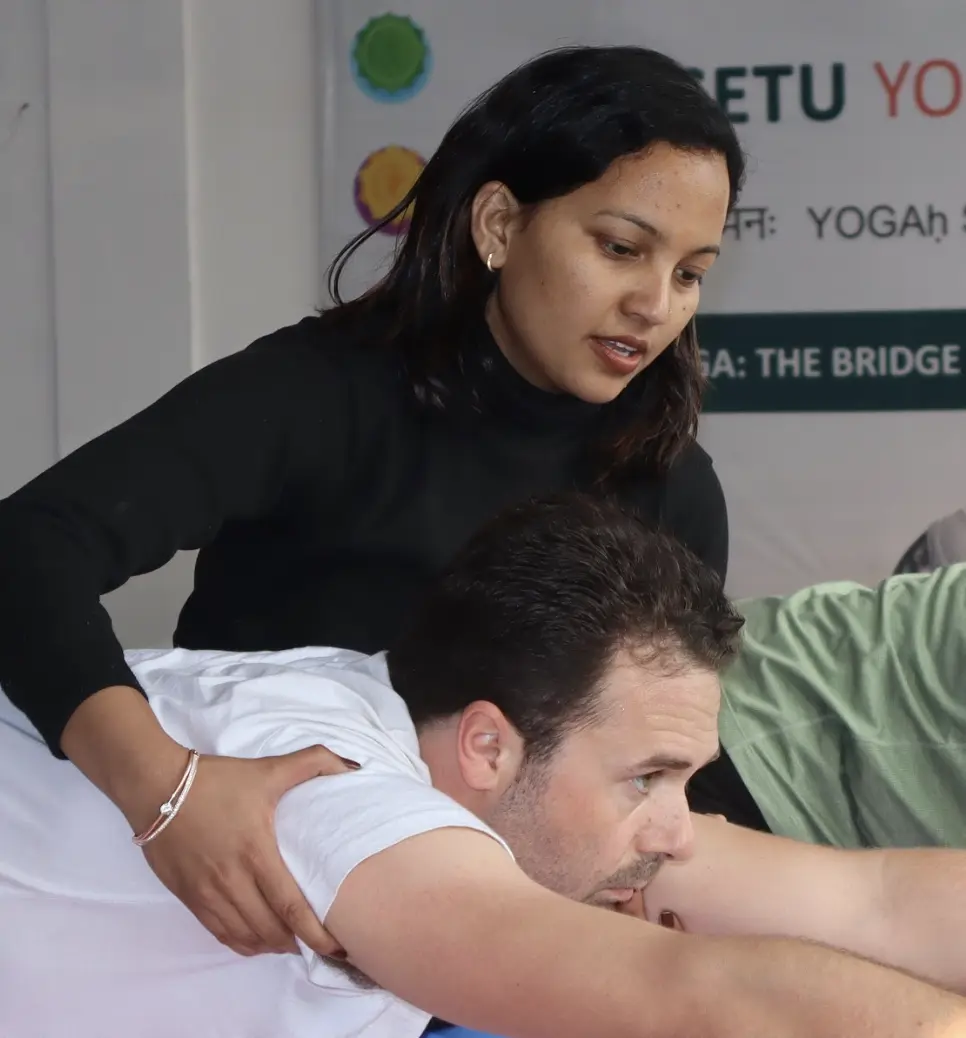
True restorative asana practice is not just about stretching—it is a systematic path of reconnecting your nervous system with profound inner peace. In the spiritual heart of Tapovan, Rishikesh, our Himalayan teachers provide personalized alignment, hands-on adjustments, and therapeutic wisdom:
- Looking to Decompress & Recharge? Immerse yourself in restorative asana, healing sound baths, and traditional Ayurvedic wellness in our All-Inclusive Yoga Retreats in Rishikesh.
- Deepen Your Teaching & Anatomy Mastery: Master the biomechanics of postures, therapeutic modifications, and Vedic philosophy in our internationally accredited 200-Hour Yoga Teacher Training in Rishikesh.
Frequently Asked Questions
What does Ananda Balasana mean in Sanskrit?
Ananda Balasana translates to “Blissful Child Pose” or “Happy Baby Pose.” It is derived from Ananda (pure spiritual joy or bliss), Bala (infant or young child), and Asana (steady posture). It reflects the natural, uninhibited hip flexibility and playful innocence of an infant.
What should I do if my tailbone lifts off the mat in Happy Baby Pose?
If your tailbone curls off the floor, your hamstrings or inner hips are tight. Release your grip on your feet and hold onto the backs of your thighs or calves instead, or use a yoga strap looped across the arches of your feet. This allows your entire sacrum and spine to stay grounded, protecting your lower back.
How long should you hold Ananda Balasana?
In a standard Hatha or Vinyasa class, holding Ananda Balasana for 30 to 60 seconds (5 to 10 slow diaphragmatic breaths) provides great relief. In a Yin or restorative practice, you can gently hold the posture for 2 to 4 minutes with props to release deep connective fascial tension.
Can Happy Baby Pose help with lower back pain and sciatica?
Yes. By flexing the hips while the back remains flat on the floor, Ananda Balasana gently decompresses the sacroiliac (SI) joint and stretches the piriformis and erector spinae muscles, relieving compressive pressure on the sciatic nerve without putting weight on the spine.