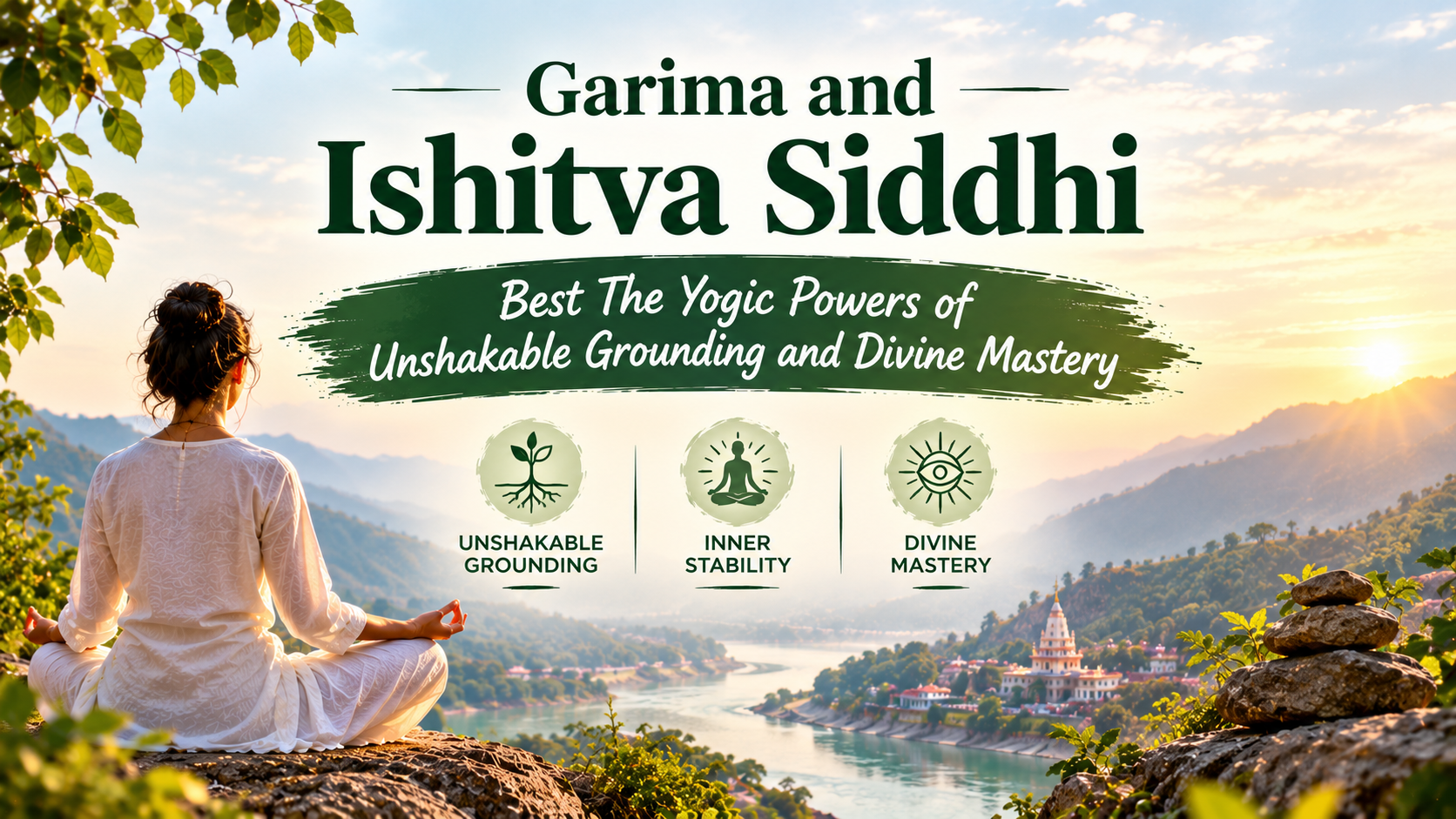
Within the profound metaphysics of classical yoga and the Vedic Shastras, the Ashta Siddhis (Eight Primordial Supernormal Accomplishments) represent the pinnacle of consciousness mastering the laws of material nature. While powers like Laghima allow an adept to transcend gravity into weightlessness, its ancient cosmic twin—Garima Siddhi—grants the capacity of infinite density, making the yogi as immovably rooted as the Himalayan mountains. Alongside it stands Ishitva Siddhi, the sacred power of divine governance, through which an enlightened practitioner achieves perfect harmony with cosmic law (Rta) and the five elemental forces (Pancha Mahabhutas).
Quick Facts: Garima & Ishitva Siddhi
- Sanskrit Etymology: Garima (गरिमा — from Gariyan, meaning dense, weighty, venerable) & Ishitva (ईशित्व — from Isha, meaning sovereign ruler, divine master).
- Ashta Siddhi Position: Garima is the polar counterpart of Laghima; Ishitva is the ultimate siddhi of cosmic alignment and spiritual authority.
- Chakra & Elemental Alignments: Garima governs the Earth element (Prithvi Tattva) at the Muladhara (root) chakra; Ishitva operates through Ether (Akasha) and the crown center.
- Primary Scriptural References: Patanjali’s Yoga Sutras (Vibhuti Pada 3.45), Shrimad Bhagavatam (Canto 11, Chapter 15), and the Hanuman Chalisa.
- Modern Spiritual Core: Cultivating unshakeable emotional resilience against turbulence and developing compassionate, selfless leadership without domination.
Classical Foundations: The Sacred Polarities of Nature
In medieval Hatha Yoga and Patanjali’s Raja Yoga, spiritual mastery is not about escaping the physical world, but deeply understanding its fundamental energetic polarities. Material creation exists in a state of eternal balance between expansion and contraction, lightness and weight, individual surrender and cosmic lordship.
“अणिमा महिमा मूर्तेर्लघिमा प्राप्तिरिन्द्रियैः ।
प्राकाम्यं श्रुतदृष्टेषु शक्तिप्रेरणमीशिता ॥”
Translation (Shrimad Bhagavatam 11.15.5): “Anima, Mahima, and Laghima belong to the physical form; Prapti governs subtle sensory perception; Prakamya rules desires of the seen and unseen; and Ishitva bestows the divine capacity to direct cosmic energies and elemental laws.”
When an accomplished yogi masters the five gross elements through meditative concentration (Bhuta Jaya), they gain the freedom to experience both polarities: dissolving gravity through Laghima Siddhi, or becoming as dense and unshakeable as the earth through Garima Siddhi.
What is Garima Siddhi? The Power of Infinite Density & Grounding
Garima Siddhi is the yogic capability to increase one’s energetic density to an extraordinary degree, making the physical or energetic vessel completely immovable by external forces. While modern readers might view this as mythical, classical commentators describe it as the complete merging of the practitioner’s subtle pranic field with the immense gravitational pull of Prithvi Tattva (the Earth element).
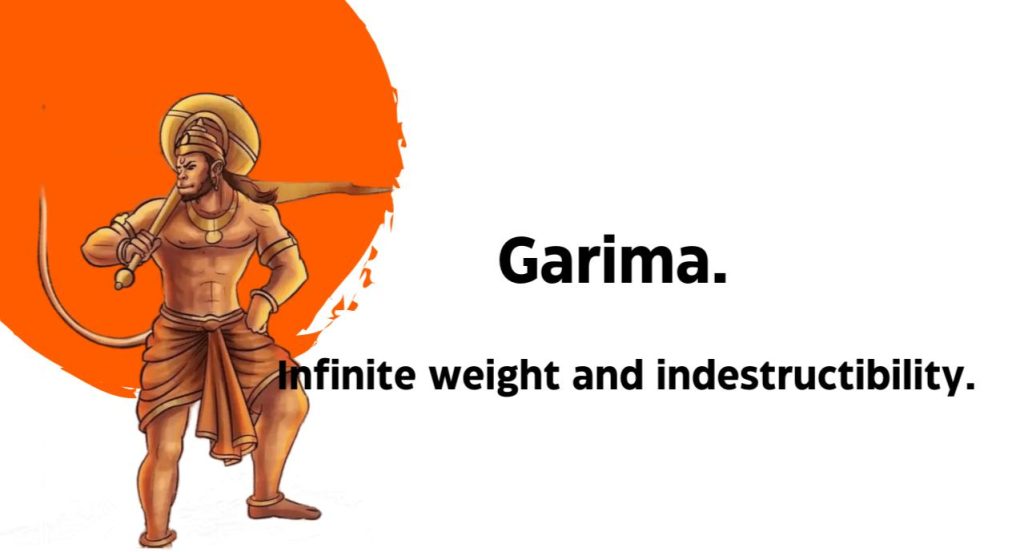
Scriptures frequently celebrate this power in sacred epics. In the Hanuman Chalisa, Lord Hanuman is revered as “Ashta Siddhi Nau Nidhi Ke Data” (the bestower of the eight siddhis and nine divine treasures). During the Mahabharata, when the mighty warrior Bhima encounters Hanuman disguised as an elderly monkey in the forest, Bhima arrogantly tries to lift Hanuman’s tail. Despite his colossal physical strength, Bhima cannot lift it even by a fraction of an inch—demonstrating the effortless, gravitational supremacy of Garima Siddhi.
At the psychic level, Garima represents unshakeable psychological presence. When a yogi is established in Garima, no insult, emotional turmoil, or worldly crisis can disturb their inner poise.
What is Ishitva Siddhi? The Art of Divine Governance
The term Ishitva stems from the Sanskrit root Isha, meaning sovereign lord or divine ruler. Unlike political or worldly power, which relies on coercion, laws, and armed force, Ishitva is the natural, spontaneous authority that arises when an individual ego dissolves completely into universal divine will.

In Vedic philosophy, the cosmos operates under Rta—the primordial moral and physical rhythm of creation. An adept who attains Ishitva does not impose personal desires onto nature. Instead, because their mind is entirely free from selfish longing (Nishkama), the five elements (Earth, Water, Fire, Air, Space) naturally obey their intention. It is the hallmark of genuine spiritual kingship—exercised with infinite compassion, protection, and moral elevation.
Garima and Laghima: How the Twin Polarities Complement Sadhana
In classical yoga philosophy, Garima and Laghima represent two sides of the same sacred coin:
| Dimension | Garima Siddhi (Density) | Laghima Siddhi (Lightness) |
|---|---|---|
| Governing Element | Earth (Prithvi Tattva) | Air & Ether (Vayu & Akasha) |
| Chakra Focus | Muladhara (Root Chakra) | Vishuddha & Sahasrara (Throat & Crown) |
| Yogic Expression | Unshakeable stability, deep roots, endurance | Effortless levitation, adaptability, freedom from gravity |
| Practical Life Wisdom | Knowing when to stand firm and unyielding in principles | Knowing when to surrender, let go, and flow with change |
Grounding Yogic Practices for Daily Living
To experience the psychological grounding of Garima and the centered poise of Ishitva in daily life, traditional teachers recommend these time-honored practices:

1. Sthira Asana: Tadasana & Virabhadrasana
In Tadasana (Mountain Pose), the practitioner plants both feet firmly into the ground, distributing weight equally through all four corners of the feet and extending upward like a mountain peak. Practicing Virabhadrasana II (Warrior II) strengthens the pelvic floor and lower chakras, cultivating fierce physical and emotional stability.
2. Prithvi Mudra (Earth Mudra)
Join the tip of the ring finger with the tip of the thumb while keeping the other three fingers relaxed and straight. Practiced for 15–20 minutes in steady seated meditation, Prithvi Mudra revitalizes bodily tissues, balances vitality, and alleviates chronic mental restlessness and anxiety.
3. Muladhara Dharana (Root Meditation)
Focus your attention on the perineum at the base of the spine. Visualize a deep terracotta-red lotus and mentally chant the seed mantra LAM (लं). This directs downward-rushing nervous energy into profound energetic stability.
Modern Life Lessons: Stability and Compassionate Leadership
In our modern world of constant notifications, shifting career demands, and emotional burnout, the timeless wisdom of Garima and Ishitva Siddhi provides essential guidance:
- Unshakeable Resilience: External circumstances or difficult personalities will constantly attempt to destabilize your peace. Embodying Garima gives you the internal weight of conviction so you cannot be swayed by temporary storms.
- Compassionate Servant Leadership: True authority does not shout, bully, or micromanage. Reflecting Ishitva means leading by noble example, listening attentively, and empowering others to realize their highest potential.
- Balance Between Rigidity & Fluidity: Understanding both Garima and Laghima ensures you never become stubbornly rigid, but instead know precisely when to stand firm and when to gracefully adapt.
Experience Deep Grounding & Spiritual Rejuvenation in Rishikesh
Discover the sacred stillness of the Himalayas at Om Setu Yogashala. Cleanse your nervous system, align your chakras, and ground your spirit through classical yoga, authentic Ayurveda, and guided meditation.
The Complete Ashta Siddhi Knowledge Series
Deepen your spiritual understanding by exploring our comprehensive, scripturally authentic guides across the entire Ashta Siddhi lineage:
- What is Prakamya Siddhi? — The supernormal power of irresistible willpower and manifestation.
- What is Prapti Siddhi? — The ability of subtle omnipresence and effortless attainment.
- What is Mahima Siddhi? — The mystical power of cosmic expansion and universal consciousness.
- What is Laghima Siddhi? — The yogic attainment of feather-light weightlessness and levitation.
- What is Vashitva Siddhi? — The power of supreme self-mastery, non-violence, and authentic charisma.
- Kundalini Awakening Guide — Awakening the dormant serpent power to pierce the chakras safely.
Frequently Asked Questions
What is Garima Siddhi in simple words?
Garima Siddhi is the supernormal yogic power of becoming infinitely dense, heavy, and rooted. At a physical level, it makes the yogi immovably heavy; at a spiritual level, it bestows absolute emotional and psychological unshakeability in the face of any crisis.
What is Ishitva Siddhi and does it mean dominating others?
No. Ishitva Siddhi means divine governance in alignment with universal law (Rta). It is not worldly dictatorship or domination. When a yogi completely dissolves their ego, the elements of nature spontaneously respond to their selfless will, inspiring others through compassion and wisdom.
How do Garima and Laghima Siddhis complement each other?
Garima and Laghima are energetic counterparts. Laghima teaches the freedom to rise above worldly attachments and become light as air, while Garima teaches the grounding required to stay deeply rooted, stable, and committed to ethical duty.
Which daily yoga practices help cultivate Garima’s grounding?
Foundational standing postures like Tadasana (Mountain Pose), Virabhadrasana (Warrior Poses), Prithvi Mudra, and deep meditation on the Muladhara (root) chakra are classical practices that build profound inner stability and physical grounding.
Conclusion
Garima and Ishitva Siddhi remind us that true spiritual attainment is neither an escape from the physical world nor an ego trip of dominance. Rather, it is the mastery of living in harmony with nature’s profound polarities: standing immovable in the truth of who you are, while gracefully aligning with the divine will of the cosmos. Grounded in virtue and elevated in consciousness, the yogi becomes an unwavering pillar of peace for all of humanity.