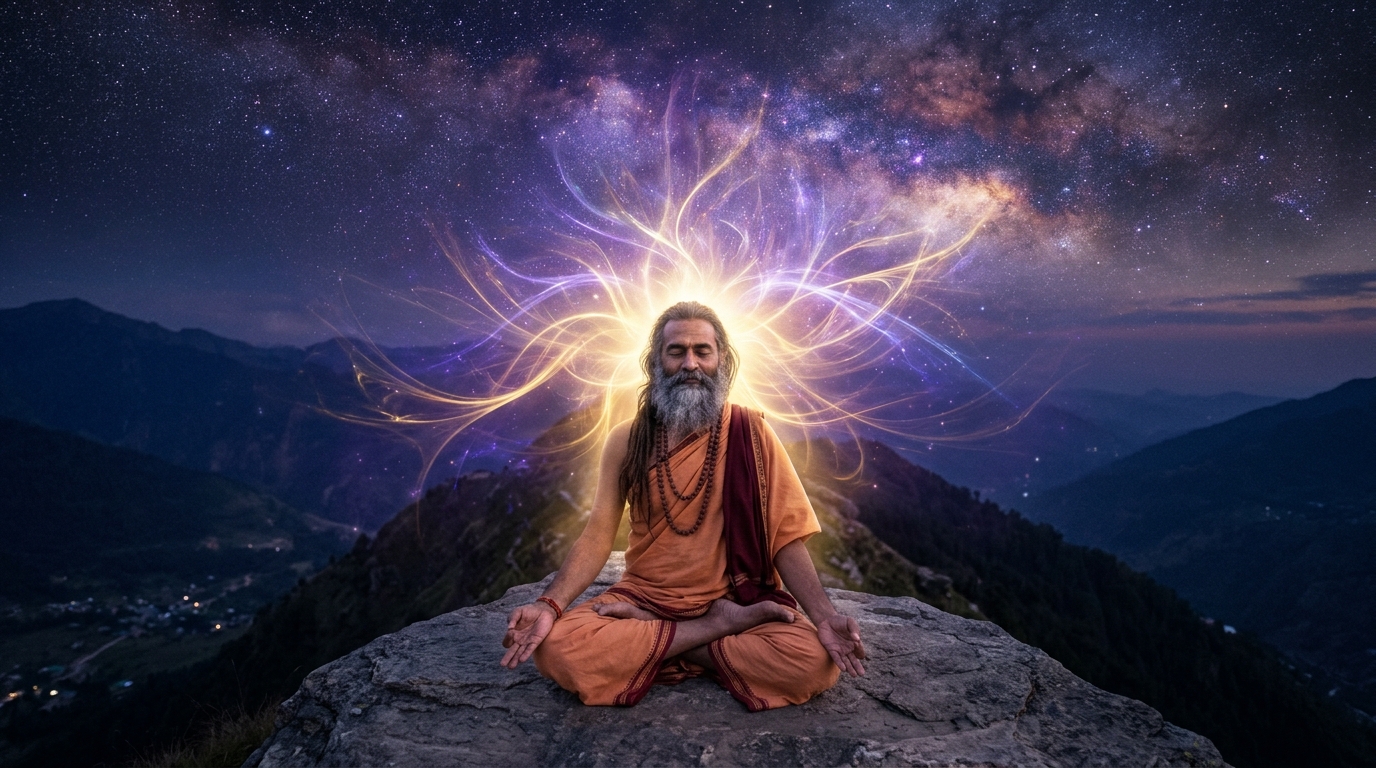
Did you know that yogis have been described as being able to consciously expand their consciousness since ancient times? Mentioned in the sacred Vedic texts and classical treatises of India, Mahima Siddhi is the extraordinary yogic ability to expand oneself spiritually, mentally, and physically. Recognized as the direct polar counterpart to the power of becoming infinitesimal (Anima Siddhi), Mahima represents the ultimate realization of vast, boundless awareness.
In the Vibhuti Pada (the profound third chapter of Sage Patanjali’s Yoga Sutras), various supernatural accomplishments or Siddhis are systematically outlined. Far from being mere mythological folklore, these accomplishments signify natural milestones that unfold when a dedicated practitioner masters deep concentration, meditation, and total absorption on the elemental forces of creation.
What is Mahima Siddhi? (Meaning & Yogic Origins)
The term Mahima originates from the ancient Sanskrit root Mahat, translating to ‘the great,’ ‘boundless,’ ‘vast,’ or ‘immense.’ In classical yoga philosophy, Mahima Siddhi is the faculty through which a practitioner transcends the narrow constraints of the physical human form to experience expansive, cosmic magnitude.
Through refined practices of Dharana (focused concentration), Dhyana (unbroken meditation), and Samadhi (spiritual absorption), the practitioner dissolves the illusion of separation. Instead of identifying solely as a localized physical body confined to a single point in space, the yogi’s consciousness merges with the cosmic matrix, experiencing oneness with the entire universe.
Mahima Siddhi in Scriptures: Lord Hanuman and Vedic Lore
In sacred Indian epics and hymns, most notably the revered Hanuman Chalisa, Lord Hanuman is celebrated as the possessor and bestower of all eight mystic perfections (‘Ashta Siddhi Nava Nidhi Ke Data’). According to the Ramayana, when Lord Hanuman needed to cross the ocean to Lanka or lift Mount Dronagiri (Sumeru) to deliver the life-saving Sanjeevani herb for Lakshmana, he manifested this divine power of vast expansion to accomplish what seemed impossible.
Similarly, in Vedic lore, Lord Vishnu’s Vamana avatar expands across the three realms of existence as Trivikrama, illustrating how the divine consciousness contains the entire cosmos within itself.
Mahima vs. Anima Siddhi: Understanding the Cosmic Polarity
In the sacred taxonomy of the Ashta Siddhis, Anima Siddhi and Mahima Siddhi represent the two fundamental poles of cosmic perception. While Anima grants the ability to become as subtle as the subatomic particle, Mahima grants the power to expand until one encompasses the entire universe:
| Attribute | Mahima Siddhi (Expansion) | Anima Siddhi (Subtlety) |
|---|---|---|
| Core Concept | Expanding awareness into cosmic, boundless size | Shrinking awareness into the subtle, atomic dimension |
| Direction of Focus | Outward expansion, vastness, cosmic union | Inward concentration, microscopic subtlety |
| Associated Element | Akasha (Ether / Infinite Space) | Anu (The subtle primordial atom) |
| Symbolic Example | Hanuman lifting the mountain; Vishnu as Trivikrama | Hanuman entering Lanka invisibly as a tiny form |
Read More: What is Anima Siddhi? – The Power of Becoming Infinitesimally Small
How Do Yogis Cultivate the Quality of Mahima?
How does an earnest yogi cultivate the energetic essence of Mahima? In classical Raja Yoga and Kundalini traditions, masters utilize three interconnected sadhanas:
1. Samyama on Akasha (The Element of Space)
In Patanjali’s Yoga Sutras, Samyama is the simultaneous application of Dharana (focus), Dhyana (meditation), and Samadhi (absorption). When a yogi performs Samyama upon the relationship between the body and the Akasha Tattva (the etheric element of space), the boundary of physical density dissolves. By meditating deeply on the boundless expanse of space, the mind takes on the quality of that space—becoming infinite, light, and unconfined.
2. Activation of Sahasrara (The Crown Chakra)
The Crown Chakra (Sahasrara), situated at the fontanelle on top of the head, is the energetic gateway to transcendent cosmic consciousness. Sitting in an upright, steady meditative posture (such as Padmasana or Siddhasana), the practitioner breathes slowly and rhythmically while visualizing a luminous, thousand-petaled white or violet lotus opening toward the infinite sky. Consistent crown chakra meditation dissolves mental pettiness and opens the subtle channels (nadis) to vast cosmic prana.
3. The Shift in Identity: From ‘Small Self’ to Boundless Consciousness
In Jnana Yoga and Vedantic contemplation, language and thought patterns directly shape the subconscious field. When we continually reinforce limitations—‘I am just this small body, fragile and separate’—the mind contracts. Cultivating the Mahima mindset involves shifting contemplation toward expansive truth: ‘I am the boundless, witnessing consciousness in which all experiences arise and dissolve.’ This daily contemplative practice rewires mental perception and liberates the spirit from fear.
Psychological Lessons of Mahima Siddhi for Modern Life
Mahima Siddhi is far more than a mystical lore of physical giants; its greatest value lies in its psychological and everyday application. In our fast-paced modern world, many people suffer from mental contraction—feeling trapped by petty worries, jealousy, social anxiety, and chronic stress.
Applying the Mahima philosophy expands the way we respond to life’s challenges. It enables you to look at problems from a cosmic vantage point, realizing how fleeting and small daily obstacles truly are. By expanding the heart, you naturally cultivate deep empathy, unshakeable mental resilience, and genuine forgiveness. You become grounded, spacious, and patient, unaffected by temporary external turbulence.
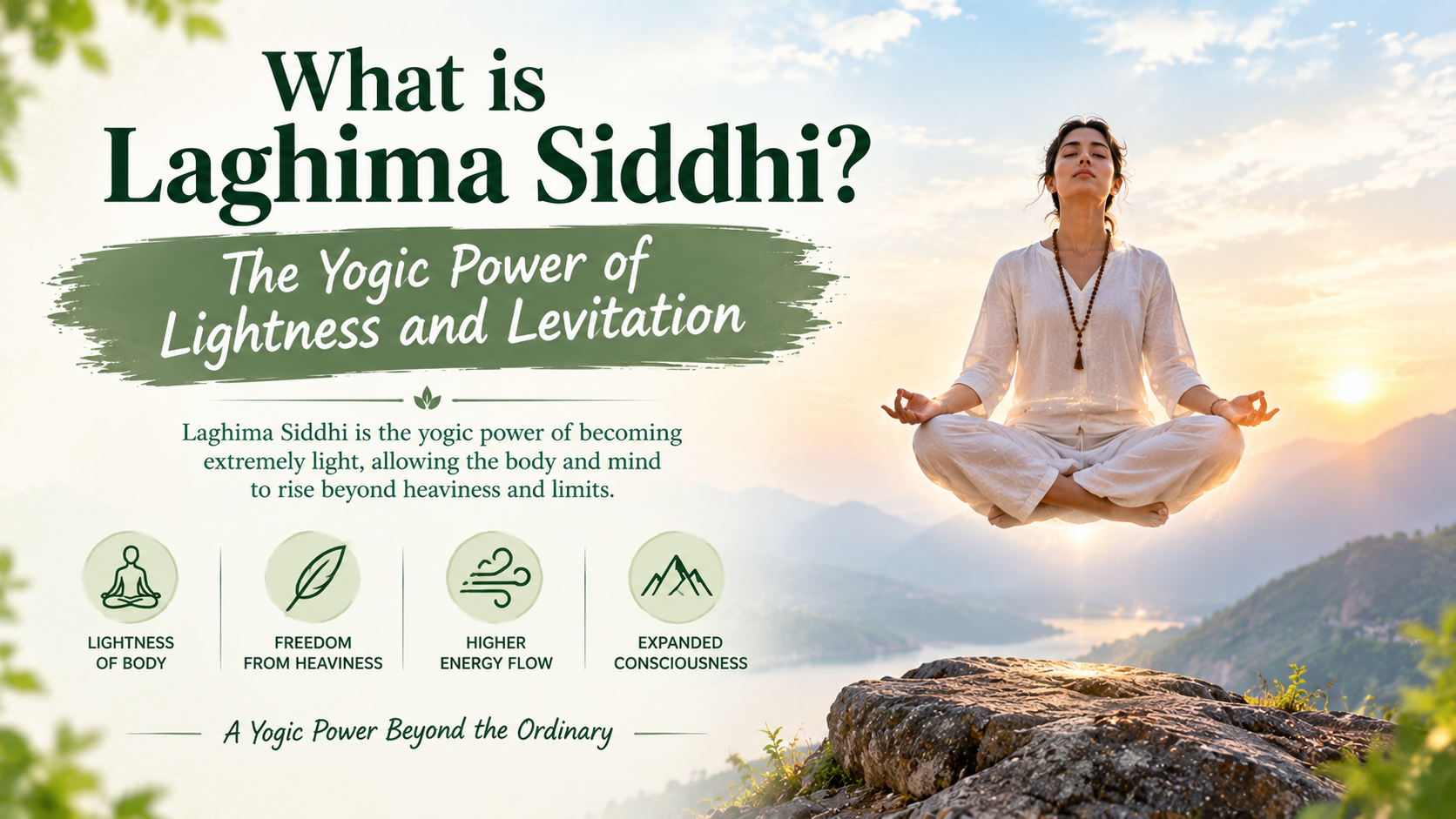
Also Explore: What is Prakamya Siddhi? – The Power of Realizing Pure Will and What is Laghima Siddhi? – The Yogic Power of Lightness
Deepen Your Practice by the Holy Ganga
From 3, 5, 7 & 14-day all-inclusive Yoga Retreats (starting at $155) to traditional Hatha yoga, Pranayama, and transformative meditation, Om Setu Yogashala hosts immersive spiritual programs led by Himalayan masters in Tapovan, Rishikesh.
Frequently Asked Questions About Mahima Siddhi
1. What does Mahima Siddhi mean in English?
In English, Mahima Siddhi translates to the power of infinite expansion or cosmic greatness. It represents the ability of an accomplished yogi to expand their subtle pranic body and consciousness to encompass vast space beyond physical boundaries.
2. Is Mahima Siddhi purely physical or spiritual?
While ancient epics allegorically portray physical growth, masters in classical yoga emphasize that Mahima Siddhi is primarily spiritual and pranic. It signifies transcending the ego’s narrow confines to experience omnipresence and oneness with the universal consciousness (Brahman).
3. Which chakra is linked to Mahima Siddhi?
Mahima Siddhi is most intimately connected to the Sahasrara (Crown Chakra), the seat of pure cosmic consciousness at the top of the head, as well as the Vishuddha (Throat Chakra), which governs the element of space (Akasha Tattva).
4. How does Mahima Siddhi connect to the other Ashta Siddhis?
Mahima is the second of the classical eight Siddhis. It perfectly balances Anima Siddhi (the power of becoming atomic) and works in tandem with Laghima Siddhi (weightlessness) and Prakamya Siddhi (unyielding will), forming an integrated spiritual spectrum of elemental mastery.
Conclusion: Awakening the Infinite Within
Mahima Siddhi is a timeless reminder of human potential. In the vision of the great Himalayan sages, we are not small, helpless creatures separated from existence. We are living expressions of the infinite consciousness that animates every star, mountain, and living soul.
Through dedicated Hatha yoga, mindful pranayama, and sincere daily meditation, anyone can awaken the true spirit of Mahima—breaking free from petty mental limits and living with an open, boundless heart.