Quick Guide: Asana Foundations at a Glance
- Classical Definition: “Sthira Sukham Asanam” — A posture that is steady and effortless (Patanjali Yoga Sutras 2.46).
- 6 Primary Categories: Standing (Stability), Seated & Forward Bends (Calm), Backbends (Vitality), Twists (Digestion), Inversions (Circulation), Restorative (Integration).
- Classical Count: 84 root asanas described in the Hatha Yoga Pradipika and Gheranda Samhita.
- Golden Rule of Practice: Never sacrifice breath quality for physical depth. Alignment protects the joints; breath awakens the prana.
Pick up a modern yoga book and you will encounter hundreds of named postures, elaborate variations, and acrobatics. Yet when traditional yogis in the foothills of the Himalayas speak of asanas, they are not describing a workout routine. They are speaking of precise geometrical shapes designed to stabilize the body so the mind can become still.
Every posture carries a specific physical alignment, a designated breathing rhythm, and an energetic seal (mudra effect). Understanding the distinct families of asanas allows you to practice with discernment—building strength where your body collapses, creating space where it contracts, and protecting your spine from repetitive strain.
What Defines an Asana? The Ancient Science of Sthira Sukham Asanam
In the foundational text of yogic psychology, the Patanjali Yoga Sutras, sage Patanjali defines posture in three words:
स्थिरसुखमासनम् ॥ २.४६ ॥
“Sthira-sukham asanam” — Posture must embody equal measures of steadiness (sthira) and comfort or ease (sukha).
If you are clenching your jaw, holding your breath, or straining through joint pain, you are performing gymnastics, not an asana. True asana practice balances muscular engagement with nervous system calmness. When steady effort replaces frantic movement, bodily restlessness dissolves, clearing the path toward pranayama and meditation.
The 6 Classical Categories of Yoga Asanas
Traditional Hatha and Vinyasa traditions classify postures by their relationship to gravity, spinal mechanics, and energetic impact. Here is the anatomical and traditional breakdown of the six core families:
1. Standing Asanas (उत्थित आसन – Utthita Asanas)
Standing postures form the bedrock of any physical practice. They ground the feet (Pada Bandha), awaken the deep stabilizers of the ankles and knees, correct pelvic tilt, and build endurance in the large muscle groups.
- Tadasana (ताड़ासन – Mountain Pose): The master template of all standing postures. Teaches four-point foot distribution, neutral pelvic alignment, and axial elongation of the spine.
- Vrikshasana (वृक्षासन – Tree Pose): Unilateral balance that strengthens the gluteus medius, stabilizes the sacroiliac (SI) joint, and trains focal concentration (Drishti).
- Virabhadrasana II (वीरभद्रासन II – Warrior II): Builds deep isometric strength in the quadriceps and adductors while expanding the chest across the coronal plane without arching the lower back.
- Utthita Trikonasana (उत्थित त्रिकोणासन – Extended Triangle Pose): Opens the hamstrings and inner groin while decompressing the lateral torso and intercostal muscles.
Primary Anatomical Benefit: Bone density preservation, functional joint stabilization, and corrective realignment of modern seated postural deformities.
2. Seated & Forward Bending Asanas (उपविष्ट एवं पश्चिमोत्तान आसन)
Forward bends are introspective. Anatomically, they stretch the entire posterior myofascial chain—from the plantaris muscle in the calves up through the hamstrings, gluteals, and erector spinae. Energetically, they soothe sympathetic overdrive and lower blood pressure.
- Paschimottanasana (पश्चिमोत्तानासन – Seated Forward Bend): Literal translation: “Stretching of the Western [back] side of the body.” Massages the abdominal organs and triggers parasympathetic activation.
- Baddha Konasana (बद्धकोणासन – Bound Angle / Cobbler Pose): Releases tension in the adductor complex, improves external hip rotation, and encourages healthy pelvic circulation.
- Dandasana (दण्डासन – Staff Pose): The baseline for all seated work. Demands active core engagement and erect spinal erectness without relying on external back supports.
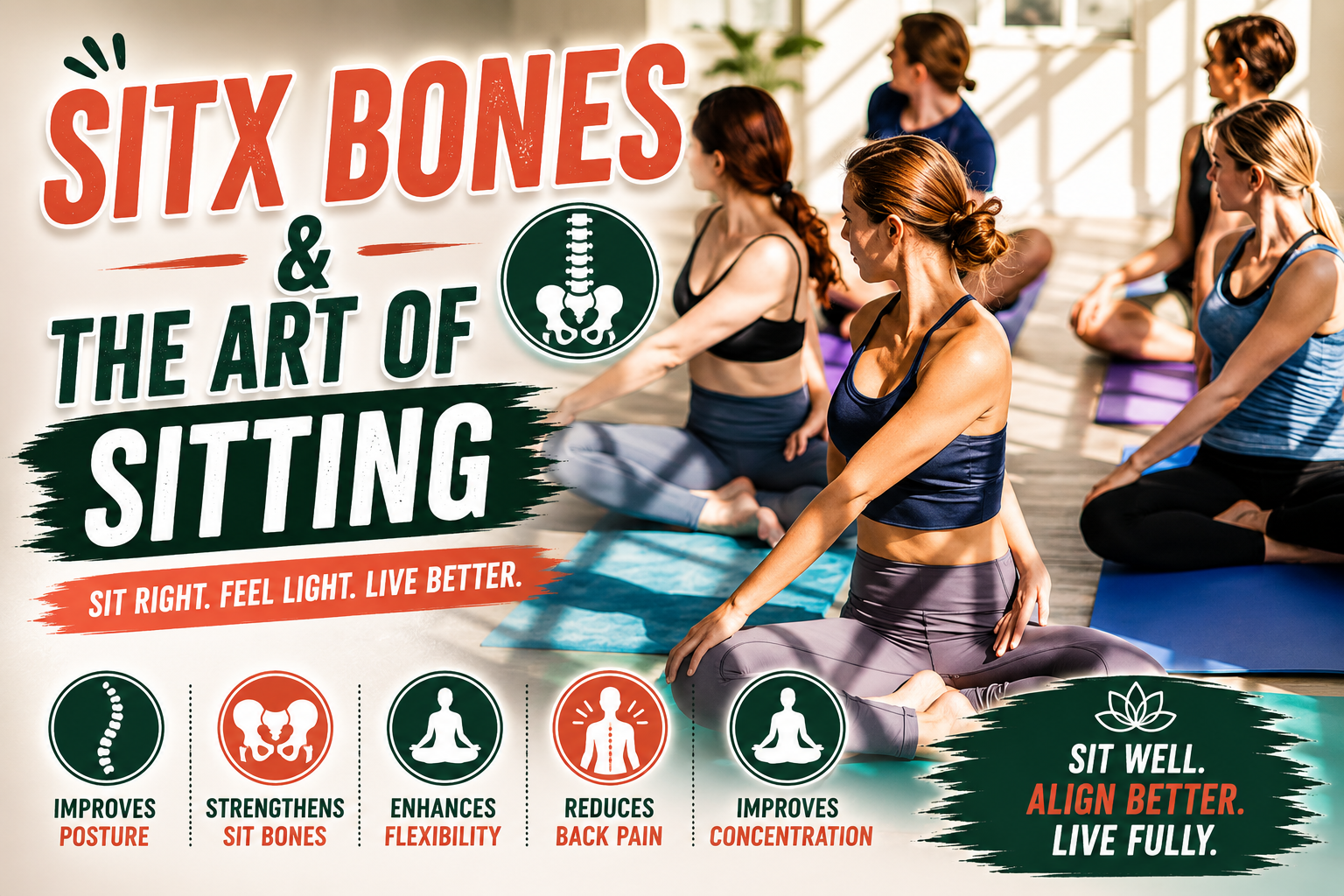
Safety Cue: Always initiate forward flexion from the hip crease (pelvic anterior tilt), never by rounding through the thoracic spine. If your hamstrings are tight, elevate your sit bones on a folded blanket to protect your lumbar discs.
3. Backbending Asanas (पूर्व पृष्ठ विस्तार आसन)
Modern desk-bound life traps the upper torso in chronic forward flexion (kyphosis). Backbends counter this by extending the spine, opening the pectoralis muscles, and stimulating the sympathetic nervous system to combat lethargy and sluggish digestion.
- Bhujangasana (भुजंगासन – Cobra Pose): Strengthens the posterior spinal chain while expanding the ribs and lung capacity without compressing the lumbosacral junction.
- Setu Bandhasana (सेतुबन्धासन – Bridge Pose): Engages the hamstrings and glutes while opening the hip flexors (psoas) and gently stimulating the thyroid gland.
- Ustrasana (उष्ट्रासन – Camel Pose): Intense anterior chain stretch requiring conscious engagement of the transverse abdominis to prevent lower-back pinching.
- Dhanurasana (धनुरासन – Bow Pose): Stretches the entire front of the body simultaneously while providing deep visceral compression to the kidneys and liver.
Key Alignment Rule: Focus on lifting through the sternum (thoracic extension) rather than bending exclusively from the flexible L4–L5 lumbar vertebrae.
4. Spinal Twisting Asanas (परिवृत्त आसन – Parivritta Asanas)
Spinal twists rotate the vertebrae along their central longitudinal axis. They gently compress the abdominal viscera, expel deoxygenated blood from internal organs, and maintain the hydration and suppleness of the intervertebral discs.
- Ardha Matsyendrasana (अर्धमत्स्येन्द्रासन – Half Lord of the Fishes Pose): Classical seated spinal twist that stimulates the pancreas, tones the abdominal wall, and restores rotational range of motion to the mid-back.
- Supta Matsyendrasana (सुप्त मत्स्येन्द्रासन – Supine Spinal Twist): A gentle floor-based variation that releases tension across the gluteal muscles and outer hips (IT band) before rest.
Breath Coordination: Inhale to lengthen the crown upward; exhale to deepen the rotation from the belly button upward. Never torque the spine aggressively with arm leverage.
5. Inverted Asanas (विपरीत आसन – Viparita Asanas)
Inversions turn the body upside down, placing the heart above the head. This utilizes gravity to facilitate venous blood return from the lower limbs back to the heart, reduces peripheral edema, and calms the endocrine system.
- Viparita Karani (विपरीत करणी – Legs-Up-the-Wall Pose): The gentlest restorative inversion. Highly effective for resetting tired legs, draining lymphatic fluid, and lowering stress hormones before sleep.
- Sarvangasana (सर्वांगासन – Shoulder Stand): Known classically as the “Mother of Asanas.” Stimulates the thyroid and parathyroid glands via chin-lock pressure (Jalandhara Bandha).
- Sirsasana (शीर्षासन – Headstand): The “King of Asanas.” Enhances cerebral circulation and demands total shoulder stability and core integration.
Safety Warning: Full inversions like Sirsasana and Sarvangasana are contraindicated for anyone suffering from untreated high blood pressure, glaucoma, detached retina, neck injuries, or during menstruation.
6. Restorative & Relaxation Asanas (विश्राम आसन)
No asana practice is complete without conscious resting postures. These poses require minimal muscular effort, allowing the central nervous system to drop out of fight-or-flight mode and integrate the neuro-muscular changes created during dynamic practice.
- Balasana (बालासन – Child’s Pose): Rests the back muscles, gently stretches the hips, and provides a psychological sense of safety and surrender.
- Shavasana (शवासन – Corpse Pose): The most deceptive posture in yoga. Demands complete physical stillness and alert mental surrender to allow prana to settle evenly throughout the nadis.
How Many Different Yoga Asanas Truly Exist? (Myth vs. Shastras)
In contemporary yoga lore, it is often repeated that there are 8,400,000 distinct yoga asanas—corresponding to the number of living species in the cycle of reincarnation. While this poetic metaphor appears in texts like the Goraksha Samhita, ancient masters selected only a fraction for human practice.
- The 84 Postures: The Hatha Yoga Pradipika (written in the 15th century by Swami Svatmarama) notes that Lord Shiva taught 84 primary postures, among which 4 are considered supreme: Siddhasana, Padmasana, Simhasana, and Bhadrasana.
- The 32 Practical Postures: The Gheranda Samhita further curates the list down to 32 asanas deemed most useful and therapeutic for human physiology.
You do not need to master 84 or 800 postures to reap the benefits of yoga. Practicing a disciplined sequence of 8 to 12 balanced asanas with continuous breath awareness delivers profound physical resilience and mental clarity.
The Golden Sequence: How to Structure a Daily Asana Practice
Practicing asanas randomly can leave the nervous system agitated. Traditional Hatha Yoga relies on a balanced sequence that warms the joints, builds heat, balances the spine in every plane of motion, and closes with grounding stillness:
- Centering & Warm-Up (5–10 mins): Gentle joint freeing exercises (Sukshma Vyayama) followed by 3–6 rounds of classical Surya Namaskar (Sun Salutations) to synchronize breath with movement.
- Standing Postures (10–15 mins): Ground the energy and build stability (Tadasana, Vrikshasana, Warrior poses).
- Balancing & Core (5 mins): Cultivate single-pointed mental focus (Utkatasana, Navasana).
- Backbends & Counter-Bends (10 mins): Open the thoracic cage (Bhujangasana, Setu Bandhasana) paired with gentle neutralizing child’s pose.
- Seated Forward Bends & Twists (10 mins): Cool down the body temperature and soothe internal organs (Paschimottanasana, Ardha Matsyendrasana).
- Inversions or Semi-Inversions (5–8 mins): Reverse venous pooling (Viparita Karani or Sarvangasana).
- Final Relaxation (10 mins): Complete, undisturbed stillness in Shavasana.
Contraindications: Practicing with Safety & Discernment
Yoga is a therapeutic discipline, but forcing a joint into an unnatural position invites injury. Keep these non-negotiable safety guidelines in mind:
- Herniated Discs / Sciatica: Avoid deep, aggressive seated forward bends (Paschimottanasana). Favor gentle axial extension and supported backbends like Sphinx Pose.
- Hypertension / Heart Conditions: Avoid long-held full inversions (Headstands, Shoulderstands) and vigorous breath retentions (Kumbhaka).
- Carpal Tunnel & Wrist Weakness: Elevate the heels of the palms on a wedge during plank and downward dog, or drop to forearms in Dolphin Pose.
- Pregnancy: Avoid prone postures (lying flat on the belly), intense deep twists that compress the uterine wall, and strong abdominal contractions.
Deepen Your Practice at the Source: Rishikesh Yoga Immersions
Reading about postures provides the mental framework, but true understanding awakens only on the mat under experienced guidance. Learning proper skeletal alignment, personalized modifications, and the deeper philosophy of asanas transforms physical exercise into a spiritual sadhana.
If you are looking to step away from daily noise and immerse yourself in traditional Himalayan practices, explore our certified programs nestled along the sacred Ganga:
- Seeking Rest & Rejuvenation? Experience daily guided asana, pranayama, and Ayurvedic care in our All-Inclusive Yoga Retreats in Rishikesh.
- Ready to Teach or Master Alignment? Build comprehensive anatomical mastery and teaching methodology in our internationally recognized 200-Hour Yoga Teacher Training in Rishikesh.
Frequently Asked Questions
What is the main difference between yoga asanas and physical exercise?
Conventional gym exercises focus primarily on external muscular hypertrophy, cardiovascular exertion, and calorie burning, often triggering sympathetic nervous activity. In contrast, yoga asanas coordinate conscious rhythmic breathing with internal organ stimulation, endocrine balance, and parasympathetic nervous activation. The objective of an asana is physical stability and mental stillness (Sthira Sukham), not exhaustion.
How many categories of yoga asanas should I practice each day?
A balanced daily practice does not require dozens of poses, but it should move the spine in every anatomical plane: flexion (forward bends), extension (backbends), lateral movement, and axial rotation (twists), combined with at least one grounding standing pose and a calming restorative finish in Shavasana.
Can absolute beginners practice all types of asanas?
Beginners should focus on foundational standing postures (Tadasana, Vrikshasana), supported forward bends, gentle backbends (Cobra, Bridge), and restorative poses. Advanced inversions like Headstand (Sirsasana) and full arm balances should be avoided until adequate core strength, shoulder girdle stability, and spinal awareness have developed under qualified instruction.
How long should you hold an asana to receive its full benefits?
In classical Hatha Yoga, postures are held for 30 seconds to 2 minutes (approximately 5 to 15 slow diaphragmatic breaths) once comfortable alignment is established. Restorative and Yin postures may be held for 3 to 5 minutes with supportive props to release deep myofascial tension.